
- All
- Product Name
- Product Keyword
- Product Model
- Product Summary
- Product Description
- Multi Field Search

Views: 151 Author: Site Editor Publish Time: 2026-08-10 Origin: Site


Off-the-shelf lighting fixtures often fail in modern office environments, leading to harsh glare, uneven light distribution, and awkward architectural integration. Facility managers, architects, and electrical contractors face a saturated market of linear lighting options. Over-specifying drives up project costs and lead times, while under-specifying results in poor employee productivity, shadow zones, and non-compliance with commercial building codes.
Navigating the technical specifications of a Custom Hanging Linear Light requires separating aesthetic trends from functional necessities. This guide breaks down the exact customization options—from continuous run layouts to control protocols—that dictate performance, installation feasibility, and long-term reliability. By understanding these core metrics, you can confidently specify fixtures that meet both architectural vision and strict occupational standards without unnecessary overhead.
Optics Over Aesthetics: Direct/indirect light distribution and low Unified Glare Rating (UGR <19) are the most critical custom options for screen-heavy office environments to eliminate headaches and eye strain.
Precision Sizing & Shadow Mitigation: Specifying a custom length linear light eliminates dark spots and shadow zones, but requires exact photometric planning and spacing-to-mounting height calculations before procurement.
Control Compatibility: Integrating dimmable office lighting requires matching the fixture’s driver (e.g., 0-10V, DALI, wireless) with the building’s existing or planned management system.
Mounting Adaptability: Suspension systems must be customized to the specific ceiling infrastructure (open plenum, T-grid, or drywall) and minimum ceiling heights to prevent installation delays and fixture sway.
Zone-Specific Specifying: Avoid a "one-size-fits-all" approach; customize performance metrics (CRI, CCT, up/down ratios) based on specific office zones like conference rooms, open workspaces, and lobbies.
Evaluating the Unified Glare Rating (UGR) is the first step in ensuring visual comfort. Office environments require a UGR of <19 to prevent eye strain and fatigue among employees who spend hours looking at monitors. High glare reduces productivity and causes physical discomfort. Selecting diffusers and micro-prismatic lenses specifically engineered to scatter harsh LED points is necessary to achieve this rating. When you walk onto a job site and see workers squinting or installing makeshift baffles over their monitors, you are witnessing a UGR failure. Proper lens selection diffuses the diode image, softening the output while maintaining the required footcandles at the desk level.
To achieve a UGR below 19, manufacturers utilize specialized micro-prismatic extrusions. These lenses feature microscopic geometric patterns that direct light downward and outward at specific angles, cutting off high-angle glare that typically strikes the human eye. When reviewing submittals, always verify the UGR rating is calculated based on the actual room dimensions and surface reflectances, not just a theoretical infinite space.
Mapping footcandles and lumens to specific workspace tasks ensures code compliance and functional utility. General office work typically requires 30-50 footcandles at the desk level. Corridors and transitional spaces need only 10-15 footcandles. Over-illuminating a space wastes energy, while under-illuminating creates safety hazards and visual strain. Accurate lumen packages must be specified based on the exact task performed in each zone. You cannot simply guess the lumen output; you must calculate it based on the distance from the luminaire to the work plane.
Consider the degradation of light over time, known as Light Loss Factor (LLF). When specifying fixtures, you must account for Lumen Maintenance (L70/L90) and dirt depreciation. A fixture that delivers 40 footcandles on day one might only deliver 32 footcandles after three years of operation in a dusty environment. Always design with a maintenance factor in mind to ensure long-term compliance with occupational safety standards.
Understanding the relationship between wattage, lumen output, and installation height dictates the success of the layout. You must calculate fixture spacing to guarantee overlapping light cones and zero shadow zones. If fixtures are spaced too far apart relative to their mounting height, dark spots will appear on work surfaces. Utilizing proper spacing-to-mounting height (SC) ratios ensures uniform light distribution across the entire floor plan. An SC ratio of 1.2 means the maximum spacing between fixtures should be 1.2 times their mounting height above the work plane.
Determine the mounting height above the finished floor (AFF).
Subtract the desk height (typically 30 inches) to find the cavity height.
Multiply the cavity height by the fixture's SC ratio provided by the manufacturer.
Use this maximum spacing dimension to lay out the grid, ensuring no desks fall outside the overlapping beam angles.
A baseline of 80+ CRI is standard for general office applications. However, upgrading to 90+ CRI is necessary for high-collaboration design hubs, video-conferencing suites, or retail-adjacent office spaces. High CRI ensures that colors appear natural and vibrant, which is required for tasks involving design, fabric selection, or high-definition video broadcasting. When you specify 90+ CRI, you are ensuring that the red spectrum (R9 value) is adequately represented, preventing skin tones from looking washed out or sickly under artificial light.
Extruded aluminum housing, high-performance PMMA diffusers, and robust thermal management systems are non-negotiable for 24/7 commercial operations. Light-duty fixtures often warp, discolor, or suffer premature driver failure due to poor heat dissipation. Specifying commercial-grade materials guarantees structural integrity over long suspension spans and maximizes the lifespan of the internal LED components. On a construction site, fixtures get bumped, moved, and exposed to dust. Flimsy plastic housings will crack during installation. Heavy-gauge extruded aluminum acts as a rigid backbone and a highly efficient heat sink.
Requiring an IES file and a detailed 3D photometric plan from the manufacturer before finalizing any custom order is mandatory. These files allow electrical engineers to simulate the exact light distribution within the specific architectural model. Skipping this step often leads to post-installation surprises, such as inadequate desk illumination or excessive wall glare. A proper photometric layout will account for the reflectance of the carpet, the paint on the walls, and the ceiling material, giving you a true representation of the final installed performance.
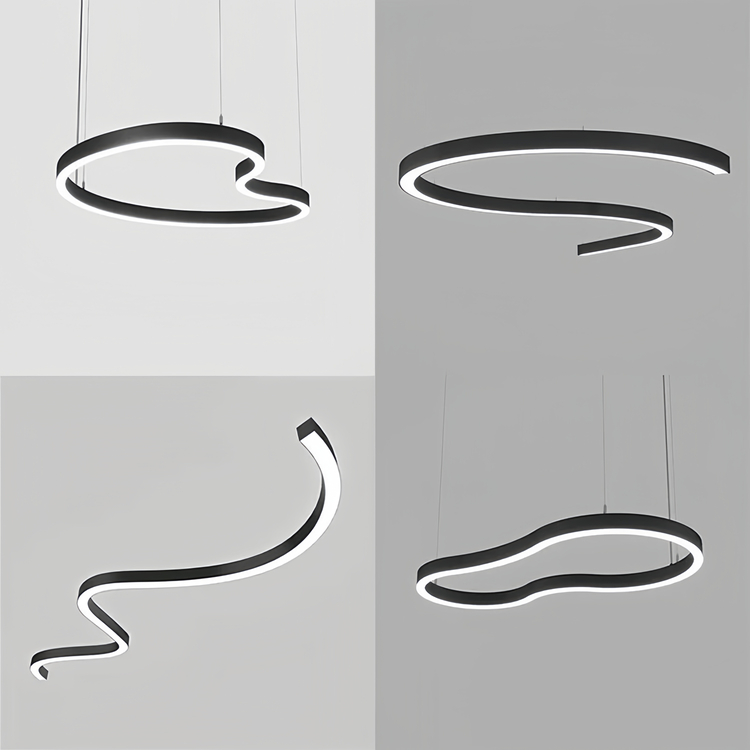
Evaluating the structural differences between continuous runs and standalone fixtures dictates the visual flow of the ceiling. Continuous runs utilize seamless mechanical and electrical connectors to eliminate light leaks and visual gaps. Specifying a custom length linear light allows you to scale the fixture mathematically to match desk dimensions, boardroom tables, and ceiling heights. This optimization ensures the cone of illuminance covers the intended work area perfectly without spilling wasted light into walkways.
Assessing the functional value versus the cost of L-shape, X-shape, T-shape, and free-flowing volumetric patterns helps guide office foot traffic and establish distinct architectural zones. Furthermore, customizing a continuous run to transition smoothly from a suspended configuration to a surface-mount or recessed setup accommodates changing ductwork or bulkheads without breaking the visual line. When running a 50-foot continuous line of light, the internal through-wiring must be sized correctly to prevent voltage drop across the run, typically requiring 12 AWG or 14 AWG internal harnesses.
Direct lighting (downlight) is best used for dedicated task lighting over individual desks. However, using it exclusively risks creating harsh shadowing. Indirect lighting (uplight) utilizes ceiling reflectance to create ambient, diffuse light. Effective uplighting requires a minimum ceiling height and high ceiling reflectance values (typically white paint). If you bounce light off a dark grey exposed deck, you will lose up to 70% of your lumen output.
Specifying custom split ratios is essential for balanced illumination. For example, a 70% up / 30% down ratio works well for high-ceiling open plans, while a 50% up / 50% down ratio provides balanced general office illumination. Customizing optics for asymmetric and wall-wash distribution directs light toward walls or signage, emphasizing brand elements in lobbies or providing uniform vertical illumination in corridors.
Distribution Type | Primary Application | Key Benefit | Implementation Requirement |
|---|---|---|---|
Direct (Downlight) | Task areas, conference tables | Maximum footcandles on work surface | Requires glare control (UGR <19 lenses) |
Indirect (Uplight) | Open plan offices, low-glare zones | Soft, diffuse ambient illumination | Minimum 9ft ceiling, high reflectance paint |
Asymmetric / Wall-Wash | Corridors, lobbies, whiteboards | Highlights vertical surfaces and branding | Precise distance calculation from the wall |
Direct/Indirect Split | General open office layouts | Balances task lighting with ambient fill | Dual-circuit wiring for independent control |
Choosing static CCT depends on interior finishes and natural daylight penetration. Options include 3000K for a warm corporate feel, 3500K for balanced neutral environments, and 4000K for cool, energetic workspaces. Evaluating the ROI of circadian-aligned systems involves tunable white technology. You must determine if the employee productivity benefit justifies the increased cost of dual-channel LED boards and specialty drivers required to mimic the natural progression of daylight. Tunable white systems require complex control interfaces, often necessitating DALI or advanced wireless mesh networks to handle the dual-channel dimming and color mixing commands.
Integrating dimmable office lighting requires selecting the correct protocol. 0-10V dimming remains the industry standard for commercial spaces. It is reliable and highly compatible, though it requires running separate low-voltage control wiring alongside the line voltage. When installing 0-10V systems, contractors must ensure the purple and pink control wires are properly isolated to prevent interference and flickering.
Specify DALI (Digital Addressable Lighting Interface) for granular, individual fixture control, bi-directional reporting, and seamless integration with complex Building Management Systems (BMS). DALI allows facility managers to rezone lighting layouts via software without rewiring the physical fixtures. For retrofits where pulling new control wires through existing walls is cost-prohibitive, evaluate wireless protocols like Bluetooth Mesh, Zigbee, and proprietary wireless ecosystems. These systems rely on nodes integrated directly into the fixture drivers, communicating via radio frequencies to wall switches and central hubs.
Customizing fixtures with integrated photocells enables daylight harvesting. These sensors automatically dim the lights in response to ambient sunlight, ensuring compliance with strict regional energy codes such as ASHRAE 90.1, IECC, or Title 24. Balancing visual minimalism with regional occupancy-sensing compliance involves choosing between embedded micro-sensors within the fixture housing and ceiling-mounted remote sensors. Embedded sensors keep the ceiling plane clean but require careful placement to ensure the sensor's field of view is not blocked by architectural elements or tall furniture.
Selecting suspension hardware for a suspended linear fixture depends on HVAC airflow and ceiling slope. Aircraft cables offer a minimalist look but may sway in high-airflow open zones, whereas rigid stems provide stability. Customizing mounting hardware and canopies is necessary to adapt to drop ceilings (using T-grid clips), drywall (using mud-in trimless canopies), or exposed structural concrete ceilings. When mounting to exposed concrete, contractors must use appropriate concrete anchors and ensure the power feed canopy aligns perfectly with the junction box.
Determining the critical limits involves the ceiling height equation. Maintain a minimum of 7.5 to 8 feet of clearance from the floor to the bottom of the fixture. Customizing suspension cables optimizes the drop length, maintaining an optimal distance from the work surface—typically 30 to 36 inches above desks—to control glare and beam spread effectively. If the fixture is mounted too high, the light will dissipate before reaching the desk; if mounted too low, it creates a physical obstruction and intense localized glare.
Specifying clear, white, or black braided power cables ensures the power cord aesthetics match the mounting suspension and blend seamlessly with the ceiling architecture. When configuring a custom office pendant light, you must weigh the trade-offs of driver placement. Housing drivers inside the fixture channel allows for easier installation in open plenums. Conversely, remote mounting allows for an ultra-slim, minimalist profile but requires accessible ceiling access panels for future maintenance. Remote drivers must be installed within the maximum allowable wire distance specified by the manufacturer to prevent voltage drop and erratic dimming behavior.
Understanding the cost and lead-time implications of standard finishes versus custom RAL colors is vital. Custom powder-coated finishes align with corporate branding guidelines or specific interior paint colors but require longer manufacturing times. Evaluating linear lights clad in PET acoustic felt can solve both illumination and sound dampening requirements in noisy, open-plan office spaces. Acoustic baffles absorb high-frequency sound waves, reducing reverberation times in rooms with hard floors and exposed ceilings.
Choosing the right optical materials dictates performance. Frosted acrylic lenses provide maximum diffuse distribution, micro-prismatic lenses offer superior glare control, and dark-light parabolic louvers deliver precise directional control and high visual comfort for specialized tasks. Parabolic louvers physically block the light source from normal viewing angles, creating a "quiet" ceiling effect where the light source is nearly invisible until you are directly underneath it.
Request complete IES photometric files from the manufacturer and run a 3D lighting simulation to verify footcandle levels and identify shadow zones before procurement.
Confirm the exact ceiling infrastructure (T-grid, drywall, or exposed deck) and specify the corresponding mounting hardware and canopy types to prevent installation delays.
Verify the selected dimming protocol (0-10V, DALI, or wireless) matches the building's existing control system and that the electrical contractor has accounted for the necessary low-voltage wiring.
Calculate the exact suspension drop length required to maintain 30 to 36 inches of clearance above the work surfaces while keeping the fixture level.
A: Standard commercial practice dictates hanging the fixture 30 to 36 inches above the work surface. This typically places the bottom of the fixture 60 to 66 inches above the finished floor, optimizing task light coverage while avoiding line-of-sight glare.
A: Custom office pendant lights allow specifiers to select exact run lengths down to the inch, specify precise direct/indirect up-down light ratios, integrate specialized dimming drivers, and configure mounting hardware tailored to specific ceiling structures.
A: A suspended linear fixture generally requires a minimum ceiling height of 9 feet. This allows for an 18-to-24-inch suspension drop and maintains the industry-standard minimum clearance of 7 to 7.5 feet from the floor.
A: Unified Glare Rating (UGR) measures the glare produced by a luminaire. In offices, a UGR of under 19 is required to prevent eye strain, headaches, and fatigue for employees working on computer monitors all day.
A: Yes. You must specify adjustable aircraft cables or swivel-stem mounting hardware. This allows the suspension system to adapt to the angle of the ceiling while keeping the linear fixture perfectly level over the workspace.


