
- All
- Product Name
- Product Keyword
- Product Model
- Product Summary
- Product Description
- Multi Field Search

Views: 0 Author: Site Editor Publish Time: 2026-07-07 Origin: Site


Standard, unsealed shop lights are a liability in professional and serious DIY workshops. Airborne particulates, shifting ambient temperatures, and fluctuating humidity rapidly degrade exposed components. This degradation reduces lumen output over time and causes premature fixture failure. Poor lighting design and inadequate fixture protection lead to task-area shadows across workbenches and machinery. These shadows increase eye strain, compromise safety, and trigger frequent fixture replacement cycles that interrupt workflow. Upgrading to an IP54 LED Linear Light provides a verifiable standard of protection. It shields internal components against dust and moisture ingress. This serves as the optimal baseline for environments demanding precision visibility, thermal stability, and hardware durability. You get consistent illumination without worrying about sawdust or condensation destroying the internal diodes.
Workshops generate massive amounts of airborne debris during normal operation. Fine sawdust from table saws, metal shavings from lathes, and chemical vapors from finishing stations constantly circulate through the air. Standard fluorescent or cheap LED fixtures lack sealed housings. Debris easily enters these unsealed units through ventilation slots or poorly fitted lenses. Dust settles directly on the diodes, ballasts, and internal reflectors. This buildup acts as a thermal insulator, causing diodes to overheat and fail prematurely. Lens clouding also occurs, severely reducing the actual light output reaching your workbench. Internal shorting becomes a real risk when conductive metal dust bridges electrical contacts inside the housing.
Moisture presents another significant hazard in these environments. Unconditioned garages, basements, and industrial spaces experience wild temperature swings between day and night. These shifts cause natural condensation to form on cold surfaces, including overhead lighting fixtures. Damp conditions wreak havoc on unprotected circuitry, leading to corrosion and ground faults. Non-industrial fixtures also struggle during winter months. Cold-start delays frustrate users in unheated spaces. Cheap ballasts and drivers lose efficiency when temperatures drop below freezing, resulting in flickering, reduced lumen output, and shortened operational lifespans.
Task-area shadows completely compromise precision work. Woodworking requires exact measurements, clean cuts, and careful joinery. Metal machining demands high visibility to monitor tight tolerances and surface finishes. Circuit assembly involves tiny components that easily disappear in poor lighting. Finishing tasks, like staining, painting, or applying clear coats, rely on even illumination to spot drips, runs, or uneven coverage. When your lighting casts harsh shadows from your hands or tools, mistakes multiply. You waste raw materials and lose valuable time correcting preventable errors.
Poor lighting also impacts human physiology and overall shop safety. Straining to see fine details causes severe eye fatigue over a long shift. Workers often experience tension headaches after hours in badly lit spaces. Dim environments naturally reduce alertness, increasing the likelihood of accidents around dangerous machinery like band saws or drill presses. Inadequate illumination often leads to non-compliance with OSHA or local occupational safety standards. Maintaining a bright, evenly lit workspace is non-negotiable for safety, accuracy, and sustained productivity.
| Environmental Hazard | Impact on Unsealed Fixtures | Impact on Shop Operations |
|---|---|---|
| Fine Sawdust | Coats diodes, causes overheating, blocks light output. | Reduces visibility, creates fire hazards inside the fixture. |
| Metal Shavings/Dust | Enters housing, bridges electrical contacts. | Causes short circuits, trips breakers, damages equipment. |
| Condensation/Humidity | Corrodes internal wiring, damages cheap LED drivers. | Leads to flickering lights, premature failure, safety risks. |
| Freezing Temperatures | Causes cold-start delays, reduces ballast efficiency. | Delays work, provides inadequate light during winter months. |
The Ingress Protection (IP) rating system provides exact specifications for environmental durability. The first digit, "5", indicates the fixture is dust-protected. This means the housing permits a very limited amount of dust ingress under extreme conditions. However, it guarantees that dust will not accumulate in a way that interferes with safe operation. A true dustproof linear light keeps critical internal components clean. You can run routers, planers, and sanders all day without worrying about destroying your overhead lighting infrastructure.
The second digit, "4", signifies protection against splashing water from any direction. Testing facilities use oscillating tubes and spray nozzles to verify this rating. It sets realistic expectations for moisture resistance in a working shop. The fixture handles condensation, high ambient humidity, and accidental liquid splashes perfectly. However, strict application limits exist. These fixtures excel in high-humidity indoor zones and covered outdoor areas. Open-sided loading bays or covered workshop porches are ideal locations. You must never expose them to direct rainfall, submersion, or high-pressure spray-downs.
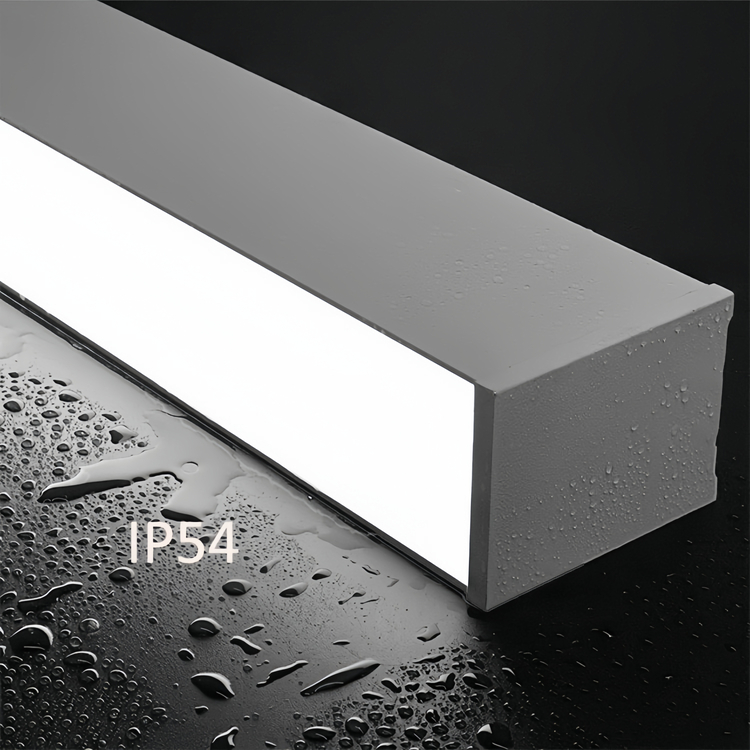
Choosing the right protection level ensures longevity without overspending on unnecessary specifications. An IP54 workshop light is the most appropriate choice for standard indoor shops. Automotive garages, assembly areas, and woodworking facilities rarely exceed IP54 parameters. It provides ample protection against the daily grind of dust and humidity without over-engineering the solution.
Sometimes, environments demand higher ratings. You must identify the threshold for upgrading to IP65 or fully vapor-tight fixtures. Facilities requiring direct hose-downs for sanitation need IP65 or IP66 ratings. Heavy outdoor exposure without a roof demands fully sealed units. Corrosive chemical presence, like in a dedicated finishing booth or battery charging station, requires specialized vapor-tight housings. If your shop involves pressure washing equipment indoors, step up to a higher rating. For typical dust and ambient moisture, IP54 remains the practical sweet spot.
Light distribution patterns dictate workspace visibility. Linear fixtures feature an elongated diode array, typically spanning four to eight feet. This shape creates wide, overlapping light pools across the room. These overlapping beams effectively eliminate shadows caused by your body, overhead cabinets, or tall machinery. Traditional round high bays act as intense point sources. They blast light straight down, creating severe hot spots directly underneath and deep, dangerous shadows everywhere else.
Ceiling height strictly dictates fixture selection. Linear lights are vastly superior for ceilings under 15 feet. They spread the light horizontally, reducing direct glare into the user's eyes. Traditional high bays create severe glare at lower mounting heights. Looking up in a low-ceiling shop with high bays causes temporary blindness and spots in your vision. Linear fixtures provide smooth, comfortable, and diffuse illumination for standard garage and basement workshops.
| Feature | IP54 LED Linear Light | Traditional Round High Bay |
|---|---|---|
| Light Distribution | Wide, overlapping pools, minimal shadows. | Focused point source, creates harsh shadows. |
| Ideal Ceiling Height | 8 to 15 feet. | 15 to 30+ feet. |
| Glare Level | Low to moderate (diffused lens). | High (intense point source). |
| Form Factor | Elongated, low profile. | Bulky, hangs down significantly. |
Not all linear lights offer the same durability in a working environment. Basic LED strips and commercial troffers feature open frames or loose-fitting lenses. They collect insects, dust, and moisture inside their enclosures. Cleaning them requires complete disassembly, which risks breaking fragile plastic clips. The sealed housing of an IP54 fixture prevents this entirely. The internal cavity remains pristine, ensuring consistent light output year after year without internal maintenance.
Standard shop lights suffer from rapid lumen depreciation. Dust settles on exposed fluorescent tubes and bare reflectors, physically blocking the light from reaching the work surface. Sealed diodes in an IP54 housing prevent this issue. You only need to wipe the exterior lens occasionally with a damp cloth. Quality IP54 fixtures also utilize extruded aluminum housings as integrated heat sinks. This thermal management system pulls heat away from the enclosed diodes. Proper heat dissipation maintains diode lifespan and preserves lumen output despite the completely sealed environment.
Understanding lighting metrics is crucial for proper shop design. Lumens measure the total light emitted by the fixture itself at the source. Footcandles (FC) measure the actual usable light reaching your work surface. A fixture might output 10,000 lumens, but if mounted too high or spaced too far apart, the footcandles at the bench will be inadequate. You must plan your layout based on footcandles, not just total lumens.
Different tasks require different footcandle baselines for safe and accurate work. General shop storage and pathways need roughly 20 to 30 FC. General assembly and mechanical work require 50 to 75 FC. Detailed inspection, precision machining, and finishing work demand 100 or more FC. Achieving these targets requires a smart layout strategy. A grid of multiple lower-wattage linear lights outperforms a sparse layout of high-wattage lights. Even spacing ensures uniform coverage and eliminates dark zones between fixtures.
Color Rendering Index (CRI) measures how accurately a light source reveals true colors compared to natural sunlight. A high CRI is an absolute necessity in a workshop. General mechanical work requires a CRI above 80. Finishing, painting, automotive detailing, and wood grain matching demand a CRI above 90. Low CRI lights make red wires look brown, obscure subtle wood grain details, and make it impossible to match paint colors accurately. Accurate color matching prevents costly mistakes in the final finishing stages.
Color temperature, measured in Kelvin, dictates the visual feel of the light. The optimal range for workshop environments falls between 4000K and 5000K. This range produces a crisp, neutral white light. It promotes alertness and high visibility without distortion. Avoid fixtures rated 6000K or higher. These produce a harsh, blue-tinted glare that causes severe eye fatigue over long periods and makes the workspace feel sterile and uncomfortable.
Proper planning prevents poor performance and shadows. Follow a systematic approach to design your workshop lighting layout before running any conduit or hanging any wire.
Workshops present unique ceiling challenges that require adaptable mounting solutions. Surface mounting directly to the ceiling works well for clean, unobstructed drywall or open joists. However, many shops have exposed HVAC ducts, plumbing runs, and tall shelving. Utilizing an industrial suspended LED light setup solves this problem. Aircraft cables or heavy-duty chains allow you to drop the lights below ceiling obstructions, ensuring an even mounting plane across the entire room.
Electrical infrastructure requires careful evaluation before installation. Daisy-chaining capabilities allow you to link multiple fixtures end-to-end using integrated connectors. This drastically reduces wiring time, conduit runs, and overall installation complexity. However, you must calculate maximum electrical load limits per circuit. Overloading a run will trip breakers and create severe safety hazards. Always consult the manufacturer's specifications for the maximum number of linkable units on a single 15-amp or 20-amp circuit.
Investing in quality lighting yields significant long-term operational benefits. The initial planning and acquisition of IP54 fixtures require more attention than grabbing basic unsealed shop lights off a hardware store shelf. However, this upfront effort is offset by extreme durability. You completely eliminate the need for fragile fluorescent tube replacements and ballast bypass wiring. The sealed housing reduces maintenance labor to a simple exterior wipe-down. Upgrading from legacy fluorescent systems also unlocks substantial energy savings over the life of the building.
Implementation mistakes can ruin a good lighting plan. Over-illuminating the space is a common risk when upgrading to modern LEDs. Too much light results in blinding reflective glare off metal machinery, polished concrete floors, and stainless steel surfaces. Mitigate this by utilizing dimmable IP54 fixtures with 0-10V dimming capabilities. Satin-diffused lenses also help soften the light output and reduce harsh reflections.
Voltage drop is another serious risk in long daisy-chained runs. Linking too many fixtures causes the lights at the end of the line to dim or flicker. Mitigate this by adhering strictly to manufacturer limits on the number of linked fixtures. Always use appropriate wire gauges to maintain consistent voltage across the entire run. Implementing waterproof workshop lighting correctly ensures decades of reliable, maintenance-free performance.
IP54 LED linear lights represent the optimal middle ground for professional and serious DIY indoor workshops. They deliver essential dust and moisture resistance without the unnecessary premium of full washdown-rated fixtures. When evaluating options, prioritize fixtures with verified IP54 certifications and extruded aluminum heat sinks. Ensure they offer CRI ratings above 80 and seamless daisy-chain functionality for easier installation.
A: IP54 lights are safe for covered outdoor areas like porches, carports, or open-sided loading bays. They handle high ambient humidity and occasional splashing. However, they are not rated for direct rainfall or high-pressure water exposure. For fully exposed outdoor applications, you need an IP65 rating or higher.
A: Yes. Quality LED fixtures do not rely on the gas excitation process used by fluorescent tubes. LEDs perform exceptionally well in cold temperatures, offering instant-on capabilities without flickering or cold-start delays, even in freezing unheated garages.
A: Focus on footcandles rather than total lumens. For general assembly, aim for 50-75 footcandles at the bench level. Precision tasks require 100+ footcandles. A standard two-car garage workshop typically requires between 20,000 and 40,000 total lumens distributed evenly across multiple fixtures.
A: An IP54 light protects against dust accumulation and splashing water, ideal for standard workshops. A vapor-tight fixture is fully sealed against corrosive gases, heavy moisture, and direct high-pressure hose-downs. Vapor-tight lights are necessary for car washes or chemical plants, but overkill for a standard woodshop.
A: For optimal light spread and minimal glare, hang linear LED lights between 8 and 12 feet above the floor. Ensure they are mounted high enough to clear overhead doors and tall materials, but low enough to maintain target footcandles on your work surfaces.
A: Yes. Fine sawdust is highly combustible. Unsealed fixtures allow dust to settle directly on hot electrical components, creating a fire risk. A dustproof IP54 housing prevents combustible particulates from reaching internal circuitry, significantly reducing fire hazards in woodworking environments.


