
- All
- Product Name
- Product Keyword
- Product Model
- Product Summary
- Product Description
- Multi Field Search

Views: 0 Author: Site Editor Publish Time: 2026-07-08 Origin: Site


Grand hotel lobbies deliver immediate visual impact. Guests experience soaring ceilings and luxurious atmospheres upon arrival. However, these architectural marvels hide significant operational complexities. High-ceiling lighting maintenance presents a constant challenge for facility managers. Procurement and design teams must balance architectural aesthetics with strict commercial requirements. They face demands for continuous run-times, strict weight restrictions, and energy code compliance. Difficult access for repairs further complicates fixture selection.
Specifying the right lighting requires a rigorous technical evaluation framework. You must look beyond simple aesthetics to ensure long-term operational viability. Evaluating a Hollow Round LED Pendant Light involves analyzing photometric performance and structural integrity. This guide provides actionable steps for selecting fixtures that meet both design intent and maintenance realities in hospitality environments.
Sizing lobby fixtures requires precise mathematical formulas rather than guesswork. Add the room length and width in feet. Convert that total directly into inches to establish a baseline fixture diameter. A lobby measuring 40 feet by 60 feet requires a fixture diameter of at least 100 inches. This ensures the hotel lobby pendant lighting anchors the space properly.
The visual weight of the hollow profile matters immensely. You must evaluate the ring thickness and height relative to the ceiling height. Thin profiles disappear in massive atriums. Thick profiles can overwhelm lower ceilings. For spaces exceeding 20-foot ceiling heights, consider multi-tier or concentric ring configurations. These layered designs create dynamic focal points. They fill the vertical void without adding excessive physical mass.
| Lobby Dimensions (L x W in feet) | Calculated Baseline Diameter (Inches) | Recommended Configuration |
|---|---|---|
| 30 x 40 | 70 inches | Single Ring |
| 50 x 50 | 100 inches | Double Concentric Rings |
| 60 x 80 | 140 inches | Multi-Tier Suspension |
| 80 x 100 | 180 inches | Custom Segmented Array |
Hospitality environments demand fixtures capable of running continuously. You must define acceptable L-ratings and TM-21 projections. Look for L80B10 at 50,000 hours or L90 at 100,000 hours. These metrics ensure the LEDs maintain sufficient lumen output over years of constant operation. Premature lumen depreciation ruins the lobby aesthetic and creates dark zones.
High-bay maintenance introduces severe logistical challenges. Lift rentals, scaffolding setup, and specialized labor disrupt lobby operations. These interventions drain maintenance budgets quickly. You must establish strict requirements for modular LED boards. Replaceable light engines are mandatory. Avoid sealed, disposable fixtures entirely. When a single diode fails, you should only replace the affected segment, not the entire massive ring.
Open, hard-surface atriums suffer from severe acoustic reverberation. Foot traffic, rolling luggage, and conversations create a chaotic soundscape. You can evaluate the dual-purpose integration of acoustic dampening elements. High-density PET felt inserts fit perfectly within the hollow center of the fixture. This transforms the lighting element into an active noise mitigation tool.
Analyze the Noise Reduction Coefficient (NRC) targets required for your space. Lighting fixtures acting as auxiliary acoustic treatments must achieve specific NRC ratings. A rating of 0.70 or higher provides noticeable sound absorption. This integration cleans up the ceiling plane by combining illumination and acoustic control into one architectural element.
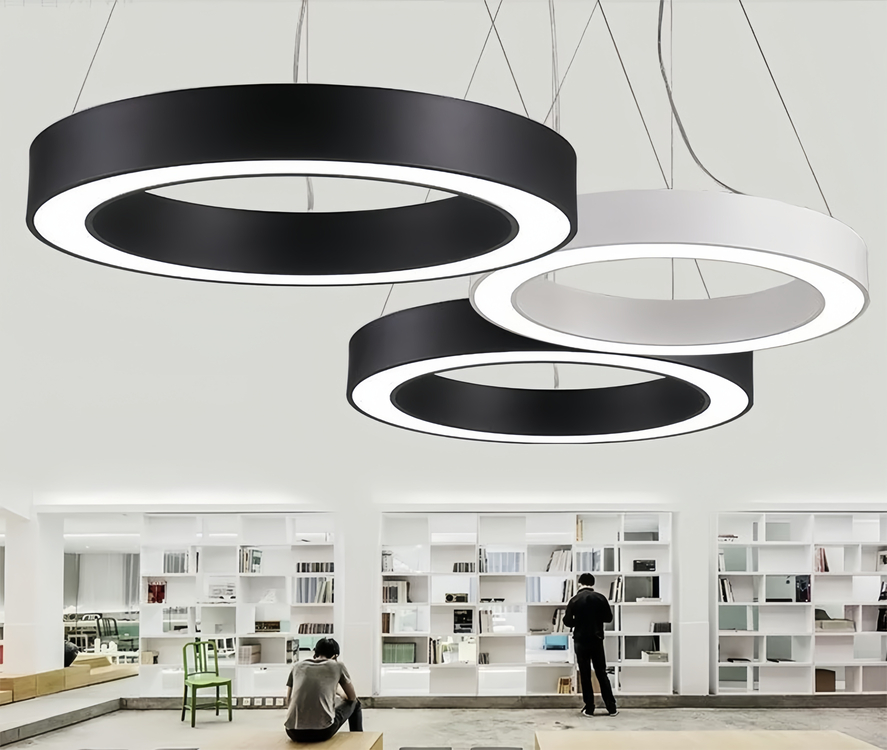
Extruded aluminum offers superior thermal management. Heat dissipation directly impacts LED lifespan and lumen maintenance. Trapped heat degrades diodes rapidly. An aluminum circular chandelier acts as an efficient heat sink. It pulls thermal energy away from the light engine. This material choice ensures the fixture meets its projected TM-21 lifespan.
Compare the weight-to-strength ratio of aluminum against heavier steel alternatives. Ceiling load-bearing limits dictate material selection in large-format fixtures. Aluminum provides structural rigidity without excessive mass. Finishing options also play a crucial role. Anodized, powder-coated, and brushed finishes resist dust accumulation. They prevent fingerprinting during installation and resist oxidation in climate-controlled commercial spaces.
Large-format fixtures face strict shipping limitations. Diameters exceeding 8 feet (2.4 meters) require segmented shipping. You cannot transport massive rings in a single piece. Evaluate the structural design of the connection points. Heavy-duty mechanical alignment pins are necessary. Internal joiner brackets prevent sag at joint connection points over time.
Optical continuity separates premium fixtures from average ones. You must eliminate visible light leaks, gaps, or dark spots at section breaks. Specify seamless rollable silicone diffusers. Alternatively, use continuous acrylic diffusers inserted on-site. These solutions ensure the illuminated ring appears as one flawless, continuous circle.
Diffuser selection dictates visual comfort. Analyze the performance of silicon, acrylic (PMMA), and polycarbonate materials. The primary goal is preventing hot spots and visible LED diodes. Silicon offers excellent flexibility for continuous rolls. Acrylic provides superior light transmission. Polycarbonate delivers high impact resistance.
You must balance light transmission efficiency with diffusion density. Highly dense diffusers hide diodes perfectly but reduce overall lumen output. Micro-prismatic optical diffusers offer a technical solution. They provide precise light directionality. This reduces glare significantly in high-ceiling environments, keeping the light source comfortable for guests looking upward.
Direct downward illumination maximizes efficiency. It pushes all lumens toward the floor. However, it creates high contrast shadows and leaves the ceiling entirely dark. Indirect illumination utilizes the ceiling as a reflector. This creates ambient, low-glare environments but requires higher wattage to achieve floor-level lux targets.
Bi-directional illumination is the standard recommendation for grand lobbies. A 70/30 or 60/40 split (down/up) balances task lighting with overall ceiling luminance. The upward light washes the architectural ceiling details. It eliminates the cavernous feeling common in tall spaces. The downward light ensures reception desks and seating areas receive adequate functional illumination.
Define target lux levels for specific hotel lobby zones. Reception desks require 300 to 500 lux for document reading and computer work. Lounge seating areas need a softer 150 to 200 lux. Transitional corridors function well at 100 lux. A single large fixture must contribute to these varying requirements appropriately.
Unified Glare Rating (UGR) determines guest comfort. A UGR below 19 is critical for seating areas and check-in desks. High glare causes eye strain and fatigue. Always request LM-79 reports during the procurement stage. Review photometrically verified IES files. Run these files through lighting software to confirm the fixture meets your specific lux and UGR targets.
Correlated Color Temperature (CCT) sets the spatial mood. Evaluate 2700K versus 3000K for hospitality warmth. 2700K mimics traditional incandescent glow. 3000K offers a slightly crisper, modern warmth. Consider tunable white systems (2700K to 5000K). These systems adjust throughout the day to match natural circadian rhythms, energizing guests in the morning and relaxing them at night.
Color Rendering Index (CRI) accuracy is non-negotiable. Specify a minimum CRI of 90. Ensure high R9 values (greater than 50). This renders skin tones, fabrics, and interior architectural finishes accurately. Standard Deviation of Color Matching (SDCM) prevents visible color shifting. Mandate less than 3-step MacAdam ellipses for multi-fixture installations. This guarantees every fixture emits the exact same hue.
Every commercial hanging light requires robust control integration. Compare available dimming protocols. 0-10V remains standard for basic commercial use. DALI-2 offers digital feedback and individual fixture addressability. Phase-cut dimming is a legacy system best avoided in new builds.
Flicker-free drivers are mandatory. Specify IEEE 1789-2015 compliance. Invisible flicker causes visual fatigue and headaches. It also creates severe banding in guest photographs and social media videos. Ensure the drivers integrate smoothly with Building Management Systems (BMS). Test compatibility with lighting control networks like Lutron Athena, Crestron, or BACnet.
Life safety codes require strict emergency lighting integration. Analyze strategies for NFPA 101 compliance. You can use localized integral emergency battery backup units (EM packs). Alternatively, connect the fixtures to centralized inverter systems. Centralized systems often prove more reliable for large-scale hospitality projects.
Housing EM battery packs in high-ceiling structures presents distinct challenges. Test-switch accessibility is a major hurdle. Maintenance staff must test these systems monthly. Wiring layouts must accommodate remote test switches. If using integral packs, ensure the indicator light and test button remain visible and accessible from ground level using specialized extension poles.
Analyze the metric of Lumens per Watt (LPW) and its impact on long-term electricity usage. High LPW ratings indicate superior energy conversion. Discuss how ASHRAE 90.1 and local energy codes dictate maximum lighting power density (LPD). These codes measure watts per square foot. Strict LPD limits influence fixture selection heavily. You must specify highly efficient LED engines to meet these stringent requirements while maintaining adequate illumination levels.
Energy codes often require automatic shutoff controls and daylight harvesting sensors. Integrating these sensors directly into the fixture profile saves installation time. It also ensures compliance without cluttering the ceiling with standalone sensor units. Review local jurisdiction requirements before finalizing the lighting schedule.
Evaluate the risks of specifying highly customized diameters or multi-tier arrays. Custom finishes often require 12 to 16 week lead times. This can delay construction schedules significantly. Compare these custom options against off-the-shelf commercial hanging lights. Standard sizes ship much faster and carry fewer manufacturing risks.
Discuss the trade-off between standard suspension cables and custom rigid stems. Standard cables offer shipping logistics advantages. They pack flat and adjust easily on-site. Custom rigid stems prevent wind-induced sway near entrances. However, they require precise factory cutting and complicate shipping due to their fixed lengths.
Aircraft cable suspension requires careful planning. Detail the requirements for 3-point versus 4-point mounting. Four-point systems make leveling large-diameter rings significantly easier. Ensure the ceiling blocking can support the dynamic load of the fixture.
Geographic building codes dictate seismic bracing requirements. Heavy fixtures in Category C through F zones require rigid bracing. You must incorporate secondary safety tethers. These fall-protection steel cables remain separate from the primary structural suspension system. They prevent catastrophic failure if the primary cables detach.
Integral drivers sit within the ceiling canopy or inside the profile itself. This simplifies initial wiring. However, it requires high-access equipment if the driver fails. Integral drivers also add to the thermal load of the LEDs, potentially reducing lifespan.
Remote drivers offer superior long-term serviceability. House them in an accessible utility closet, maintenance room, or adjacent lower-level drop ceiling. Maintenance staff can replace failed drivers instantly without lifts. The primary risk is voltage drop over long distances. You must calculate the appropriate wire gauge (AWG) based on the distance to prevent loss of lumen output.
| Distance to Remote Driver | Recommended Wire Gauge (AWG) | Voltage Drop Risk Level |
|---|---|---|
| Up to 20 feet | 18 AWG | Low |
| 21 to 50 feet | 16 AWG | Medium |
| 51 to 100 feet | 14 AWG | High |
| Over 100 feet | 12 AWG | Critical (Requires Engineering Review) |
A: Calculate the ideal diameter by adding the room's length and width in feet, then converting that number to inches. For a 50x50 foot lobby, a 100-inch diameter fixture serves as a strong baseline. Grand lobbies often require fixtures ranging from 48 inches to over 120 inches to properly anchor the volumetric space.
A: Use anti-static dusters on extension poles for routine cleaning to prevent dust buildup. To minimize mechanical maintenance, always specify remote drivers located in accessible closets. For massive fixtures exceeding 20 feet in height, install motorized lowering mechanisms or winches to bring the fixture safely to floor level.
A: Yes, provided it utilizes high-output LED engines and a bi-directional illumination model. The downward light must deliver 150-300 lux to the floor, while the upward light illuminates the ceiling. Always verify the lumen output through IES files and photometric software calculations before installation.
A: Remote placement removes the driver from the high-ceiling fixture and places it in an easily accessible utility room. LED drivers fail more frequently than the diodes themselves. Remote placement allows facility teams to replace faulty drivers immediately without renting expensive scaffolding or disrupting lobby operations.
A: Specify fixtures that utilize seamless rollable silicone diffusers or continuous acrylic lenses inserted on-site after the metal frame is bolted together. Additionally, ensure the manufacturer uses heavy-duty mechanical alignment pins and internal joiner brackets to prevent the metal segments from sagging and creating light leaks.
A: DALI-2 is the superior choice for modern commercial installations. It provides digital feedback, individual fixture addressability, and smooth dimming down to 1%. It integrates seamlessly with advanced building management systems, allowing precise control over the lobby's atmospheric lighting throughout different times of the day.


