
- All
- Product Name
- Product Keyword
- Product Model
- Product Summary
- Product Description
- Multi Field Search

Views: 0 Author: Site Editor Publish Time: 2026-07-06 Origin: Site


Commercial architecture is transitioning from rigid, grid-based troffers to dynamic, continuous illumination systems that define spatial flow. Architects and facility managers struggle to balance architectural aesthetic differentiation with strict functional requirements, such as glare reduction, uniform foot-candles, and energy compliance, in open-plan and multi-use workspaces. The Y-Shape Splicing Linear Light serves as a specialized modular solution that breaks linear monotony. It facilitates complex directional branching in office layouts and maintains continuous, seamless illumination without compromising technical performance.
The foundation of this system relies on a modular architecture built from extruded aluminum profiles, continuous roll-out optics, and internal LED arrays. Mechanical and electrical splicing joints allow designers to combine and expand the overall system length, geometric shape, and localized power or wattage. When assembling these runs on-site, the mechanical joiners must align the extrusions perfectly to ensure the optical diffusers snap in without buckling.
Advanced splicing linear lighting systems utilize lens LED strips featuring diode-over-lens technology. This approach provides ultra-uniform, dot-free lighting across the diffuser surface, outperforming traditional SMD LED boards that often create visible hot spots. The lenses distribute the light evenly before it hits the primary diffuser, ensuring a clean aesthetic even when the fixture is dimmed to low levels.
Profile dimensions dictate the visual weight and spatial impact of the suspended architectural lengths. Common commercial profiles measure around 55mm by 75mm. These dimensions provide enough internal volume to house integral drivers and manage thermal dissipation effectively. Ultra-slim profiles, ranging from 5mm to 35mm in width, offer a minimalist look but often require remote driver installations due to space constraints.
Coordinating profile scale with ceiling height is a primary design consideration. In spaces with exposed ductwork and high decks, a larger profile prevents the lighting system from looking insubstantial. In lower-ceiling environments, slim profiles maintain headroom and prevent the fixtures from dominating the visual field.
The 120-degree Y-shape node provides geometric advantages over traditional splicing methods like L-shaped corners, T-splices, plus-shaped crosses, and rounded corners. The Y-shape configuration enables the creation of hexagonal grids, organic branching structures, and triangular patterns that avoid rigid 90-degree commercial grid layouts.
Engineering tolerances for a Y-shape splicing node are tight. The node must maintain structural rigidity when suspended or surface-mounted. If the die-cast joiners have too much play, the entire suspended grid can warp, leading to misaligned optics and visible seams. Installers rely on precision-machined alignment pins and heavy-duty set screws to lock the geometric shapes in place before hoisting them to the ceiling.
Establishing baseline foot-candle requirements is the first step in planning an office ceiling light layout. Lobbies typically require around 300 lux, while open-plan desks need 500 lux for detailed tasks. A Y shape LED light distributes lumens across multi-directional axes, providing different coverage patterns compared to isolated, straight linear runs.
Photometric planning verifies uniform light distribution beneath complex, branching configurations. Lighting designers use IES files in software like DIALux or Relux to model the space.
Eye strain, fatigue, and screen glare are major concerns in monitor-heavy commercial environments. Optical diffuser technologies, including micro-prismatic lenses, opal acrylics, and louvered glare baffles, manage the light output to improve visual comfort. Micro-prismatic lenses are particularly effective at directing light downward while suppressing high-angle glare.
The Unified Glare Rating (UGR) standard quantifies the psychological glare of a lighting installation. Achieving a UGR of less than 19 is necessary for a modular linear pendant suspended over active workstations. This rating ensures the light source does not cause discomfort or reflect harshly off computer screens.
Balancing direct downward task lighting with indirect upward ambient lighting improves the overall spatial quality. Direct lighting provides the necessary foot-candles on the desk surface. Indirect lighting washes the ceiling plane, utilizing it as a secondary reflector to distribute soft, ambient light throughout the room.
This direct/indirect configuration reduces the "cave effect" and lowers contrast strain. When the ceiling is illuminated, the contrast between the bright light fixture and the dark ceiling is minimized, making the environment more comfortable for occupants working long hours.
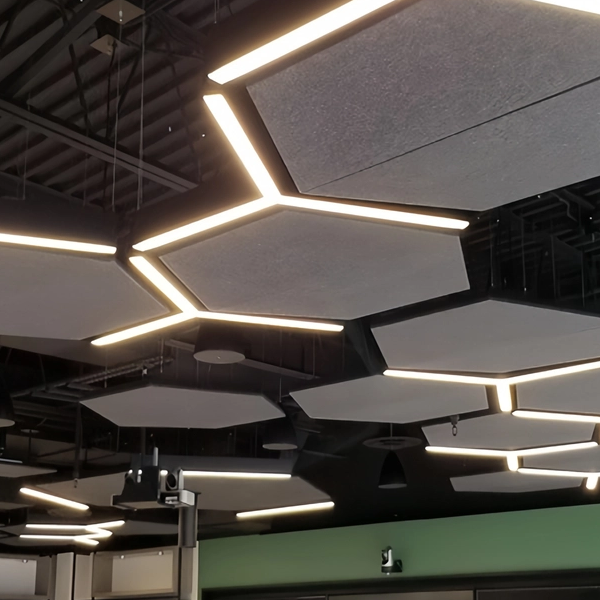
Different zones require specific lighting configurations to support their functions. Lobbies and reception areas benefit from bold, branching Y-shape patterns that capture brand identity and define spatial transition zones. Open-plan workstations utilize interlocking hexagonal or organic grids to provide uniform desk coverage without duplicating fixture runs.
Conference rooms require lighting aligned to coordinate with trapezoidal or modular conference tables. Focusing light on collaborative zones ensures participants can read documents clearly while maintaining a comfortable ambient light level for presentations.
| Zone | Lighting Goal | Recommended Configuration |
|---|---|---|
| Lobbies | Brand identity, spatial transition | Large-scale Y-shape branching patterns |
| Workstations | Uniform task lighting, low glare | Hexagonal grids, UGR < 19 diffusers |
| Conference Rooms | Focused collaboration, architectural alignment | Custom shapes mirroring table geometry |
Customizable splicing angles and continuous profiles create organic architectural flow that intuitively guides foot traffic from entryways to work hubs. Physical light lines act as structural cues in high-ceiling, open-concept designs. By following the branching paths of the lighting system, occupants can navigate large floor plates naturally.
High-efficacy LED chip selection directly contributes to building standards like LEED and WELL. These systems must be compatible with commercial dimming protocols, including DALI, 0-10V, and DMX, and integrate with daylight harvesting sensors to maximize energy savings.
Routing low-voltage control signals and dimming lines through Y-shape splicing joints requires careful planning. The internal wiring channels must separate the line-voltage power from the low-voltage control wires to prevent signal degradation or interference across the continuous runs.
Custom Y-splicing nodes, specialized joiners, and continuous lenses require a higher initial capital expenditure compared to off-the-shelf, standalone linear fixtures. Specifiers must weigh this upfront premium against the long-term adaptability of a modular system. If the floor layout changes, the modular system can be expanded, reconfigured, or shortened, providing flexibility that static fixtures cannot match.
Replacing an LED board, lens segment, or driver within an interconnected, geometric grid requires accessible components. Integral drivers offer sleeker aesthetics but result in heavier fixture profiles and internal heat challenges. Remote drivers provide easier access and lighter fixture weight but require accessible ceiling plenum space to house the driver enclosures.
Hanging complex, multi-fixture geometric grids introduces structural risks, such as ceiling sag or cable failure. Installers must calculate point loads at splicing nodes precisely. Utilizing aircraft cables with adjustable heavy-duty grippers and coordinating structural bracing with the ceiling grid framing ensures the installation remains secure over time.
Visible seams, light leakage at 120-degree joints, and thermal expansion causing gaps over time detract from the architectural aesthetic. Specifying precision die-cast splicing joiners and continuous roll-out light-blocker gaskets mitigates these risks. Single-run continuous diffusers that overlay internal joints provide a clean, uninterrupted line of light.
Long, continuous runs of splicing linear lighting risk voltage drop, color shift, or localized dimming. Proper circuit loading design is mandatory. Strategic placement of primary and secondary power feeds at designated Y-nodes, along with strict adherence to manufacturer-specified maximum run-length limits, ensures consistent illumination and color temperature across the entire system.
The Y-shape splicing linear light is a highly functional, scalable system that bridges structural architectural design with high-performance task lighting in non-linear commercial spaces. Specifiers should prioritize manufacturers providing validated photometric IES data, robust mechanical joiners, and proven low-glare optics.
A: The primary advantage is architectural flexibility. The 120-degree Y-shape nodes allow the creation of organic, branching layouts and hexagonal grids, breaking away from traditional, rigid 90-degree linear designs while maintaining continuous illumination.
A: Light leakage is prevented by using precision die-cast mechanical joiners, internal light-blocker gaskets, and continuous roll-out diffusers that cover the seams between individual aluminum profiles.
A: Yes, they are fully compatible with standard commercial dimming protocols, including 0-10V, DALI, and DMX. The control wires are routed internally through the splicing nodes alongside the power feeds.
A: For active workstations and office environments where employees use computer monitors, a Unified Glare Rating (UGR) of less than 19 is recommended to prevent eye strain and visual discomfort.
A: Integral drivers offer a cleaner look as everything is contained within the fixture, but they increase weight. Remote drivers make the fixture lighter and easier to maintain, provided you have accessible ceiling plenum space to hide the driver boxes.


